Wednesday December 27, 2017

Ranked-Choice Voting with a Supermajority Requirement


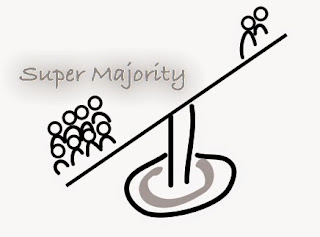
Some elections require a supermajority to cause an action to happen. A supermajority means more than a majority, and the most common supermajority requirements are 2/3 or 3/4 of the voters.

In this post we explain how you can implement a supermajority requirement for your online elections with OpaVote.

Why a Supermajority?

Most elections require a majority to enact a change because it allows you to make progress and move forward with a decision. If supermajorities were always required, then you could be stuck with the status quo and be unable to move forward.

Supermajorities are usually required for decisions of a more serious nature, such as removing a person from an office. For some decisions, it makes sense to stick with the status quo or not make a decision unless there is a supermajority who agree.

Supermajority Requirements with more than Two Candidates

Although supermajorities are somewhat rarely used, they are even more rarely used when there are more than two candidates or options to be considered. One example that I have seen is when a group is considering whether to endorse one of multiple candidates running for an office. The group wants to endorse one candidate, but only wants to do the endorsement if a supermajority of members agree. Otherwise no endorsement is made.

When there are more than two candidates, then you need ranked-choice voting (RCV). In this situation, you need to be careful to instruct the voters how to cast their votes. Voters must:

  1. rank the candidates in order in preference, and
  2. only rank candidates who they want the organization to endorse and not rank candidates who they don't want endorsed.

This is different from a typical RCV election where voters should be instructed to rank all candidates because later choices cannot hurt earlier choices.

 An RCV election typically ends when there are two candidates remaining, and the candidate with the most votes is declared the winner. For example, Alice may beat Bob with 55% of the votes. But how do we determine whether Alice is supported by a supermajority of voters for the endorsement?

The easiest way to do this is to recount the same votes with Approval Voting (and OpaVote lets you do this recount for free). If Alice has received approvals from a supermajority of voters, then Alice has been ranked on a supermajority of ballots, and she should receive the organization's endorsement.

If Alice wasn't ranked on a supermajority of ballots, then the organization could decide not to endorse any candidate or could decide to hold a second election to decide whether to endorse Alice and require a supermajority for the second election.

Saturday December 2, 2017

OpaVote has the most Secure Elections

For important elections, you need to make sure that your online election provider has high security. With the recent news about the hacking of U.S. politicians and elections, you can't be too paranoid.

We recently decided to do a security review, and we'd like to share our results with you.  In addition, we also did a security review for a few of our competitors.

There are websites that perform automatic checks of other websites to make sure they are using recommended security practices.  Below, we created a table that shows the results from two of these websites for OpaVote and some of our competitors.

In the table below, "A" is the highest score and "F" is the lowest score. Use the links in the table to verify the results yourself.

Friday October 27, 2017

Increasing Voter Turnout in your Elections

Getting voters to vote in your online elections can be a daunting task. Here, we'll give you some tips for increasing your turnout.

At a high level, voters will vote if they care about the election and if you make it easy for them to vote. We see a lot of different types of elections at OpaVote, and the elections with the best turnout are high school elections for prom king and queen. It is easy for the students to vote (they know all the candidates), and many students care deeply about the outcome!

Send Reminder Emails

This is the easiest and best thing you can do. OpaVote has a feature to send reminder emails to all voters who have not yet voted, and we allow you to do this every three days. Here is a typical example of how reminders work in practice.

When you launch the election, 20% of your voters may cast votes in the first day. For the second and third days, almost nobody votes. You send a reminder after the third day, and on the fourth day, 18% of your voters vote. You send another reminder three days later, and another 16% of voters cast votes. You've just increased your turnout from 20% to 44%, which is a huge improvement.

Make it Easy for Voters to Learn about the Candidates

For many elections, the voters don't know much about the candidates and they need to go out of their way to learn about who they are voting for. You need to make this really easy for the voters, and OpaVote makes this really easy for you.

OpaVote has description fields where you can include information about the candidates. If you have one contest, then there will be one description field. If you have multiple contests, then there will be a description field for each contest.

In these description fields, you can include summaries of the candidates, photos of the candidates, and links to other resources, such as your own web page with a summary of the candidates or candidate web pages. Make use to use these description fields to make it easy for the voters to learn about the candidates and decide who they would like to vote for.

Get your Voters Excited About the Election

Reach out to your voters early and often to let them know about the election. Whether by email, social media, or at meetings, let them know well in advance about the election. This increases awareness of the election and also encourages more candidates to run in the election.

In addition to using OpaVote's reminder emails, send emails via your own email lists both before and during the election and explicitly inform them that they will be receiving an email from OpaVote. This helps voters recognize the OpaVote voting email among the oodles of email they receive every day.

Consider Changing Your Organization's Structure

This last one is much harder, but I'm including it here because, for some organizations, low turnout is caused by the structure of their organization. Here are a few examples:

  • Do you have many uncontested elections or where the number of candidates is less than the number of positions to be filled? If so, many voters won't vote because their vote doesn't matter. Consider how to get more people to run as candidates or reducing the number of positions being filled.
  • Are there too many contests on your ballot? Voters are busy people and they are much more likely to vote if there are 2-3 contests than if there are 25 contests. Consider reducing the number of contests to reduce the burden on voters.
  • Do the voters care about the subject matter of the election? Maybe you don't need an election to determine who will bring donuts to the next meeting. Elections are a burden to voters so only hold elections where they are actually needed.

Friday October 20, 2017

Guest Post: Free Voting Method and Bad Apple Sorts

This is a guest post from Mike Sawyer who runs a blog at Dare to Ask! and who collaborates with Prof. Brian Zurowski of Davidson College.  Mike has some great ideas to promote ranked-choice voting and also how to allow voters to express more information about their preferences.


When Brian Zurowski and I started a project on voting theory, we needed a mission statement to keep us on track and avoid duplicating the good work of so many others.  Our mission statement is:

To familiarize the public with and build trust in Ranked Choice Voting 
thus paving the way to better group decision making at every level.

The vast majority of group decisions that most of us encounter are small, often casual in nature.  Small elections pose some unique problems.  Jeff O’Neill talked about a few of these in his blog article Elections with a Small Number of Voters.  But exposing the public to small less consequential elections is the best way to build trust so we needed to solve these problems.  The first question we must ask is, “How can we build trust in any voting method when seemingly all methods can disagree about how to find the one right choice?”  A voter doesn’t have to be familiar with Arrow’s Impossibility Theorem to see the problem.  Actually mathematicians created this problem by framing the objective too loosely saying the perfect voting method must reflect the “will of the people.” In our view this phenomenon is as my grandmother would say is, “a blessing in disguise.”  Simply put, “the will of the people” can have an entirely different meaning for a close-knit cooperative group of friends than it would in say a hotly contested political election.  The challenge is this, “Can we tailor the voting algorithm to the ‘mood’ of the election?”

To demonstrate, let’s compare the instant runoff voting method to the Coombs method.  With the IRV method we successively eliminate the choice with “the fewest first place rankings” while with Coombs we successively eliminate the choice with “the most last place rankings.”  Run these two algorithms on a series of randomly generated ballots and you will likely have a close election in which the two methods agree as to the best choice.  In the real world ballots are not randomly generated; that’s the whole point of elections.

We often expect individual voters will have a “positive focus” (focus on their top or top few choices) but a decision among friends is more likely to have a “negative focus” (focus on their bottom few choices).  Let’s say a group of friends are deciding which movie to see.  Depending on genre you’re probably happy to see most of the new movies as long as you haven’t already seen it.  You have a negative focus because your first criterion is that it be one you haven’t yet seen.  It is likely that everyone in your group has not only a similar negative focus but also prefer to select a movie no one in the group has seen.  This calls for the more “inclusive” Coombs algorithm, because it’s more likely to eliminate everyone’s last choice(s) than the more “competitive” IRV.  I prefer to call Coombs voting a BAS (bad apple sort) because it’s like successively throwing out the worst apple in the basket until only the prize apple remains.

While in the case of selecting a movie or a meeting time, we can make an educated guess that most voters will have a negative focus best served by a more inclusive algorithm; this is not always the case.  In the 2016 Republican primary some voters were for Trump and some wanted “anyone but Trump.” The primary was determined by a plurality vote, which by definition the most “competitive” voting method.  Focus is a personal matter, so it was manifestly unfair for all voters to be stuck with a competitive method.  So the next question is, “Can we allow individual voters control the focus of their own vote?”  This turns out to be easier than I would have expected.

There is a hybrid between IRV and BAS, where each choice is scored (number of first place votes less number of last place votes) and the choice with the lowest score is successively eliminated until only the winner remains.  For tidiness we would design it so half of your vote is “credited” toward your first choice and half is “debited” against your last choice.  If you credit 100% of your vote to a positive focus this duplicates IRV results, while if you debit 100% to a negative focus you have placed a BAS vote.  But since “focus” is a personal in nature, why not let each voter decide how much of his single vote to credit or debit by clicking on a slide bar (avoiding even fractions)?  Rather than guessing whether a “competitive” or “inclusive” algorithm best serves the group, we just let the voters set these parameters.  As a bonus the resulting odd fractions almost guarantee no ties in any elimination round thus solving another common problem with small elections.

Another common form of voting approval voting offers its own unique advantages.  Here you can place one vote for each acceptable choice, as many as you want.  Think of these acceptable choices as “peas in a pod” and your vote says, “I’ll take any one of these.”  By being more flexible you increase the odds that one of these will win but lose control of picking between the peas in the pod.  Would it make sense to allow voters to insert a “pod” instead of a single choice on their ranked choice ballot?

To see the logic of using pods you need only imagine you are voting (say instant runoff) on a list of restaurants for your groups luncheon tomorrow. Your preference is Mexican cuisine and you see three Mexican restaurants on the list, but you’ve been to none of them, so you group them in a pod and rank the pod first on your ballot. It’s not that just any one will do, but your best bet is the one others rank highest. This is tallied by counting one first place vote for each choice in the pod reducing the chance that any of the three will be eliminated. This is in effect an approval vote followed by individual rankings.

You might have ranked this pod in second place in which case the pod (with its surviving members) becomes an “approval pod” only when your first choice is eliminated. In fact a ballot could have multiple pods by simply stringing together consecutive choices that have only trivial differences. An RCV ballot with five choices would have not just 120 voter profiles but 520 (if I did that right). “Approval Pods” (or perhaps Coombs disapproval pods) should be possible with most single winner RCV algorithms. Effective use of approval pods may gain a small strategic advantage for more flexible voters, but for the most part the choice is a trade-off sacrificing “selection” (the ability to choose between “peas” or pod members) in exchange for “protection” (greater assurance that at least one pod member will survive).

The voters will handle pods by giving all its peas the same numerical ranking while the algorithm will treat all omitted choices as a last place pod (the field pod).  All this may not make the process of voting any easier for the average voter.  In fact we know he will have a lot more to consider as well as a lot more to say with his vote.  If he wants he can still cast a simple plurality vote, a regular approval vote, a standard IRV or BAS.  He can also mix any blend of these he wants.  It may seem challenging, but I can tell you after years of coffee drinking I still haven’t found the perfect blend and I’m still trying.

Brian and I agree this method which we might call “free voting” will serve voters well in small elections but have dissenting opinions on how well this might be accepted in larger political elections.  My opinion is, “It doesn’t matter” as long as it works for the small casual electorate.  It serves the objective of building trust in RCV.  The way voters use it will tell us something about their preferred voting method we can use as a guide in larger elections.  And after all it may just work.

The critical size threshold is where scientific polls and professional campaigns come into play, not to mention the influence of foreign powers.  Today’s average voter is clueless about the relationship between competitive voting and the polarized political atmosphere.  A political campaign where the objective is for your candidate is “be liked by the most voters” is quite different from one where the objective is “be disliked by the fewest voters.”  Highlighting the difference are strategies such as belittling your opponent which swells the ranks of both these groups.  If we can develop a voting app that brings the differences to light and empowers voters to react to the threats it would be a great service.

After thoughts:

  • I’m going to throw this out.  It occurred to me a two-stage elimination algorithm might give us purer results (just a hunch).  By purer I mean a greater success rate against the tests in Arrows Impossibility Theorem.  Stage-one would be to remove the choice with the highest score to a “safe zone” and then successively repeat this process on the remaining choices until the last choice not moved to the safe zone is eliminated. Stage-two is to do it again and again eliminating one choice per round.
  • I am an advocate of BAS voting because it strongly counters polarizing campaigns.  Everybody claims to hate mudslinging ads, but we all know the work and they work by creating divisiveness. I’m not sure how this argument carries with the public.  But divisiveness is the very same tool the Russians have used to disrupt the democratic process.  Developing the argument around foreign interference just might be much more powerful.


Thursday September 14, 2017

STV with Constraints

The single transferable vote (STV) is an amazing voting system because it naturally provides proportional representation. This means that the demographics or interests of the elected candidates will tend to match the demographics or interests of the voters.

Some organizations want to use STV for their online elections, but also want to require that the elected candidates meet a specified requirement. For example, an organization might want to require that half the elected candidates are women and half are men.

It is fairly straightforward to impose constraints like this in an STV election with OpaVote, and in this post, we provide instructions for how to do this. As an example, we'll consider an organization with 10 candidates (denote them as W1, ..., W5 and M1, ..., M5) running for 6 positions, and the organization requires that the 6 positions are filled by 3 women and 3 men.

The first step is to simply run an STV election. If the outcome of the election meets the constraints, then you are done! If not, then we take action to make sure the constraint is met. In particular, we remove candidates from the election to make sure the constraint is met.

An STV count proceeds in rounds (here are example STV results). At one round in the results, a constraint will be violated. For example, at round 6, we may have 3 men elected (M1, M2, and M3) and 1 woman elected (W1), and at round 7, a fourth man (M4) may be elected. We now have a constraint violation at round 7!

The solution is to eliminate M4 and M5 from the election and recount the votes. You can do this by creating a "Count" at OpaVote using the ballots from the election. Before counting the ballots in an OpaVote Count, you have the option to remove one or more candidates from the ballot. For this second count of the votes, we now elect 3 women and 3 men and we are done.

While this is straightforward, there is one quirk that I want to warn you about. It is possible (although very unlikely) that W1 is not a winner of the second election even though she was a winner of the first election. In other words, it is possible that the three women elected in the second election are W2, W3, and W4. This may seem surprising at first, but it actually makes sense. Under the imposed constraints (equal men and women), the voters believe that W2, W3, and W4, are the best women candidates to represent them.

You can also impose more complicated constraints. For example, a sports club may want to elect 2 tennis players, 2 swimmers, and 2 golfers. After a first count, tennis player may violate a constraint and extra tennis players are eliminated. After a second count, an extra swimmer may be elected and extra swimmers are eliminated.  A third count may then produce results that meet the constraints.

Sunday September 3, 2017

Customer Support at OpaVote

I'm using this blog post to expand on how you can get customer support for using OpaVote for online voting and our philosophy of customer support.

Customer support is a tricky thing. Most customers are great and a pleasure to deal with, but then there are those customers... The ones who probably spend their free time writing vitriolic comments on blog posts and news articles.

 First off, we provide top notch support. When you contact us for support, you reach me, an expert in online voting who knows the OpaVote product upside down and backwards. I can understand your question and quickly provide a clear and concise answer.


As a consequence, we cannot provide 24x7 support. We only want experts answering your questions and we don't think your typical 24x7 operators are able to meet our high standards. We do, however, answer many support questions immediately, most within an hour, and just about all of them within 12 hours. Check our online forum to see our response times.

You can reach us in three different ways:
  • Online Chat -- You'll see a yellow chat icon on the bottom right of most pages. Click on this to start a chat session with us. This is available during extended business hours (8am to 8pm Boston time) and is best for simpler questions. If you don't get a response right away, leave your email address in the chat box and we'll respond to you via email.
  • Support Forum -- We have a support forum that works better for longer questions. We prefer this over sending a private email to us, because others may benefit from seeing the question and answer.
  • Private Email -- You can send us a private email as well to the team@ email address. Use this if you question relates to payments or any other sensitive information.
Before contacting us for support, please make sure that you (1) read our documentation and (2) try a test election. Many questions can be answered this way and this is often the quickest way to get an answer to your question. We are generous about answering questions, but if your question can easily be answered by one of the aforementioned ways, we may politely ask you to RTFM (read the fine manual).

Some questions are too complicated for our free support.  The following are some examples:
  • Asking us to fix a mistake you made to an election in progress. This requires a manual database update that we prefer to avoid.
  • Detailed or complicated questions about the different voting methods we provide.
  • Step by step assistance about how to run an OpaVote election for those people who don't want to read our fine manual.
For questions like these, we need to ask you to pay a support fee of US$50 for up to one hour of support.

We hope this blog post helps you better understand our support process and we look forward to helping you with your elections!

Sunday August 27, 2017

Elections with a Small Number of Voters

Elections with a small number of voters can be tricky in terms of determining a winner in a reliable way. I experienced this recently in doing a KwikVote (our new website for doing quick polls) to select a restaurant for dinner among a group of 9 friends.

By small number of voters, I mean a small number of voters relative to the number of candidates or options. If you are deciding between two things (e.g., go out to dinner or stay home and cook), then the number of voters doesn't really matter, but if you are selecting a restaurant from 10 possible restaurants, then it is hard to get a good result with only 9 voters.


Here are the results of my restaurant poll using plurality voting:
Not only do we have a tie (which is more likely with a small number of voters) but no candidate has a majority. We could simply do a tie break to select a winner, but what if Giordano's was everyone's second choice? That might be a better outcome for the group.

Instant runoff voting allows you to select a majority winner and here is the last round of an IRV count:
In this round, 20byNine was eliminated and the vote transferred to Park Corner. Now we have a majority winner, but the results don't feel particularly satisfying. It is possible that Giordano's was the second choice of everyone else and that still might be a better outcome.

A ranked ballot gives us lots of information about the preferences of the voters, but we are using only the first choices of the voters and the second choice of the one voter who voted for 20byNine. Why not look at second or other choices on the ballot? Two other voting methods do this: Condorcet voting and the Borda count.

Here are the results using Condorcet voting:
This table shows who would win pairwise elections between the restaurants, and Park Corner is again the winner. The row for Park Corner shows that it beats all of the other restaurants and the margin of victory.  Now we can be more confident that Park Choice is a good choice.

Here are the results using the Borda count:
With the Borda count, a candidate gets 9 points for a first choice, 8 points for a second choice, and so forth. Again, Park corner is the winner.  Now we can be REALLY confident that Park Corner is a good choice.

In this example election, the four different voting methods produced the same result so Park Corner is the clear winner. In other situations, the methods may produce different results, and in these situations, it is useful to consider the Condorcet winner and the Borda count winner in ultimately deciding which restaurant to go to.

As a final note, it is worthwhile to compare elections with a small number of voters against elections with a large number of voters. For elections with a small number of voters (relative to the number of candidates), we need more information to make a good decision because there are many candidates to choose from. Plurality and IRV don't provide as much information about voter choices as do Condorcet voting or the Borda count, so these latter two may provide a better decision. If we are just selecting a restaurant (as opposed to electing a president) it makes sense to count the votes multiple ways to ultimately select a winner.

For elections with a large number of voters, we have a large amount of information regardless of which voting method we use. For these kinds of elections, it makes more sense to choose a voting method based on other merits of the system as opposed to just the amount of information used by the method as I've discussed here and here (and here and here).